
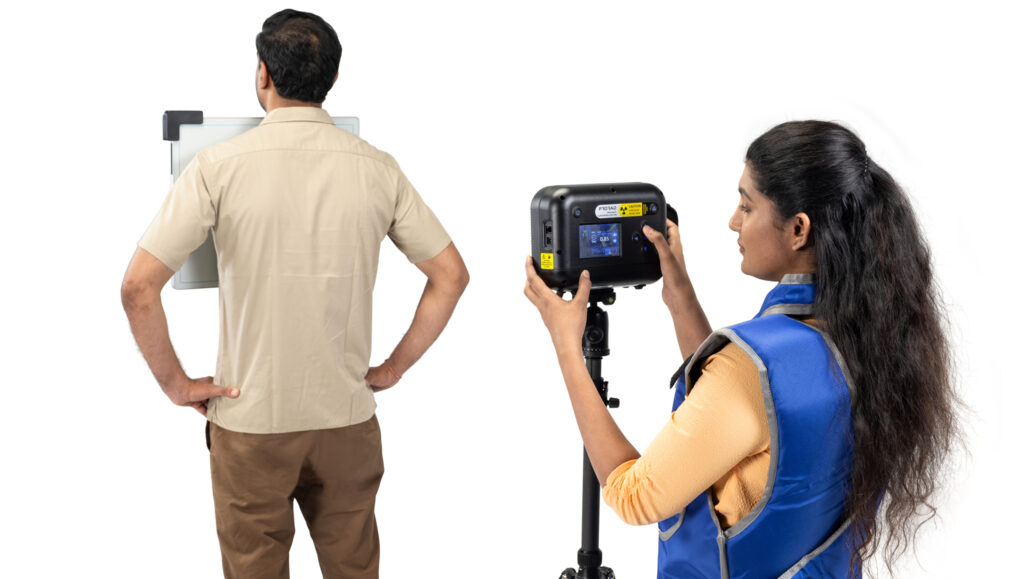
At the Villianur Health and Wellness Centre in Puducherry, the family member of a tuberculosis (TB) patient steps in for a quick X-ray and gets in front of a plate, lifting up his necklace over his head to prevent disruption. A lead apron-clad technician holds up a portable device that looks like an SLR camera with a black lens and clicks an image. Within minutes, the result is out — he is declared TB-free.
In that short span of time, the images of the chest X-ray had shown up on the laptop at the TB screening desk where an AI tool, fed with chest scan data of TB patients, had found no white patches in his lungs.
What are ICMR-validated devices?
There are three such AI-enabled X-ray devices that have been validated by the Indian Council of Medical Research (ICMR) – LabIndia’s Mine2, Mylab’s MyBeam, and Prognosys’ Prorad Atlas. In fact, Prognosys is a sister company to Molbio, which is behind the cost-effective, portable, battery-operated molecular diagnostic machine called TrueNat that is being extensively used in the country’s TB programme. The validations have shown that these devices produce X-rays comparable in quality to the ones produced by digital X-ray devices found in hospitals.
What about costs?
Over the years, the sensitivity of the X-ray detectors has improved, so has the collimation – meaning there is minimal scattering and leakage from the X-ray beam in the generator. Very little radiation is now needed to get good quality scans. This is the reason now we can have hand-held devices that do not require much infrastructure, said Santosh Kumar, business head, LabIndia, which used to import the devices from a South Korean company and has now started manufacturing it in India through licensing.
Read More